Kaizen: A Factory Story review. With a Showa salaryman's story like a morning drama by an overseas indie, improve the manufacturing process of all products!
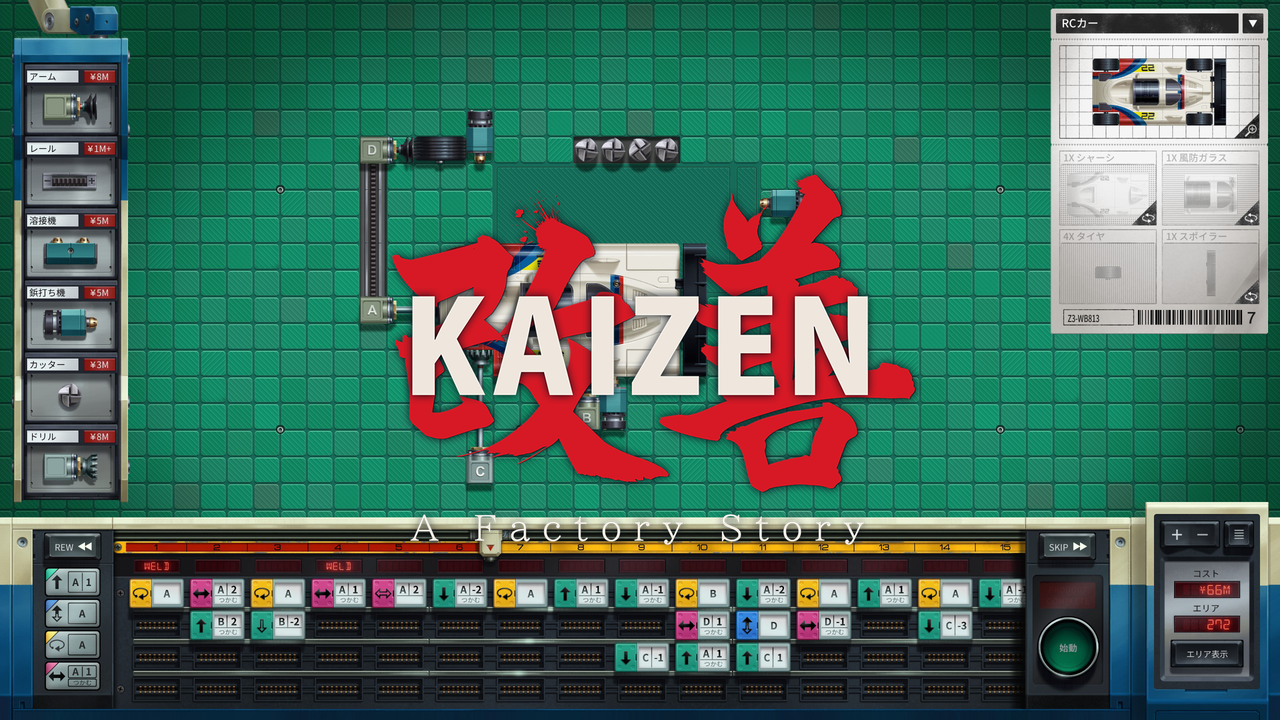
A legendary overseas indie game developer who once announced his retirement from game development is back in earnest! Moreover, the theme is Japan's manufacturing, which was burning in the midst of the bubble era? One such game is Kaizen: A Factory Story.
The game is available on PC and Japanese. It is available on Steam from today. The list price is 2300 yen, and it is currently 2070 yen in the release commemorative sale.
The game is available on PC and Japanese. It is available on Steam from today. The list price is 2300 yen, and it is currently 2070 yen in the release commemorative sale.
Coincidence, who is responsible for this work, has worked on Spacechem and Shenzhen I/O. A new studio by Zach Barth, a central figure in Zachtronics, known for unique puzzle games with the theme of optimization and programming.
If you go back in time, "Infinifactory", which was also the origin of the idea of "Minecraft"This game is a full-fledged comeback (*) in which Mr. Barth, one of the most important figures in the overseas indie game scene, has withdrawn his retirement for various reasons and sent it out into the world.
If you go back in time, "Infinifactory", which was also the origin of the idea of "Minecraft"This game is a full-fledged comeback (*) in which Mr. Barth, one of the most important figures in the overseas indie game scene, has withdrawn his retirement for various reasons and sent it out into the world.
Learn about the "Matsuzawa spirit" manufacturing in Japan during the bubble period!
The story is set in Japan in the late 1980s. The seven chapters depict the Japanese-American protagonist David Sugimoto, who gets an international job at Matsuzawa Kogyo, a group that manufactures various things, and learns the essence of "Matsuzawa spirit" manufacturing while interacting with people from all over Japan.
Of course, there is also the design and "kaizen" of the manufacturing process for various products from underwear to scooters. Arrange the parts and machine tools, arrange the work panels to be executed on each machine, and clear when the product is completed according to the sample properly.
Of course, there is also the design and "kaizen" of the manufacturing process for various products from underwear to scooters. Arrange the parts and machine tools, arrange the work panels to be executed on each machine, and clear when the product is completed according to the sample properly.
![[IMAGE]](https://cimg.kgl-systems.io/camion/files/famitsu/47215/ad5621bbbf37704adee034725e7eb0498.jpg?x=767)
In the past, Zachtronics' works had two major elements: "optimization of the production line" and "programming of control processing", but this time it can be said that the puzzle is largely close to the former.
You don't need to write programming code, you just need to think about where to move the parts and how to combine them with a limited number of machines and commands, and the results of each turn are as they look, so they are clear at a glance. If you change your mind during trial and error, you can easily select multiple parts, machines, and work panels with the mouse and move them, so it's quite easy to understand.
You don't need to write programming code, you just need to think about where to move the parts and how to combine them with a limited number of machines and commands, and the results of each turn are as they look, so they are clear at a glance. If you change your mind during trial and error, you can easily select multiple parts, machines, and work panels with the mouse and move them, so it's quite easy to understand.
![[IMAGE]](https://cimg.kgl-systems.io/camion/files/famitsu/47215/a082c1e6f2cf8f3249385f462a80eb10d.jpg?x=767)
And most of the problems can be forcibly cleared by increasing the number of machine tools, so the difficulty is quite easy compared to past games. There are a total of 33 levels to challenge before completing the story mode, and if you are purely interested in the difficulty and quantity of the puzzles, it may be a little unsatisfactory for hardcore Zachtronics fans.
A story about a humane salaryman who is about to be a morning drama
However, what is more important in this work is the story element. Not only do the story parts often appear in between the puzzles, but each product that is the subject of the puzzle episode also has a story before and after each time.
In the case of coffee makers, there is a stereotypical gag that "Americans don't drink much black coffee" (which is not actually the case) and a joke that "American coffee is thin". It's not just a puzzle, it's part of the story of the main character who struggles in a foreign country while being challenged by cultural differences.
In the case of coffee makers, there is a stereotypical gag that "Americans don't drink much black coffee" (which is not actually the case) and a joke that "American coffee is thin". It's not just a puzzle, it's part of the story of the main character who struggles in a foreign country while being challenged by cultural differences.
![[IMAGE]](https://cimg.kgl-systems.io/camion/files/famitsu/47215/a798a7ef9384ddd1b35d808655e319325.jpg?x=767)
Whether that's what Zachtronics fans want, the richness of the story element is a real surprise. The story of David, who comes from the United States and is suddenly assigned to a town factory, is intimidated by radio gymnastics, and his growth by solving difficult problems while being seconded to factories all over Japan is like NHK's morning drama.
It's really predictable that Izakaya and Yatai, who are loved by foreigners for some reason, will come out, but it's interesting that the stubborn father leaks the truth while exchanging cups, although the resolution of the understanding is too high, although it is a little tricky.
The story was written by Matthew Sage Burns, who is also Japanese-American. It tells the story of cross-cultural exchange at a time when the United States was panicking at the breakthrough of the Japan economy, which was on the verge of dropping a flying bird, with the perfect balance of exaggeration for humor and not absurdity.
It's really predictable that Izakaya and Yatai, who are loved by foreigners for some reason, will come out, but it's interesting that the stubborn father leaks the truth while exchanging cups, although the resolution of the understanding is too high, although it is a little tricky.
The story was written by Matthew Sage Burns, who is also Japanese-American. It tells the story of cross-cultural exchange at a time when the United States was panicking at the breakthrough of the Japan economy, which was on the verge of dropping a flying bird, with the perfect balance of exaggeration for humor and not absurdity.
![[IMAGE]](https://cimg.kgl-systems.io/camion/files/famitsu/47215/a7567d5fa4cfafa722c26e818cada8b50.jpg?x=767)
![[IMAGE]](https://cimg.kgl-systems.io/camion/files/famitsu/47215/a9aa5aff599e54124545f898df403bf5c.jpg?x=767)
![[IMAGE]](https://cimg.kgl-systems.io/camion/files/famitsu/47215/ac4490550c93009e58de2f63f40fbc3b1.jpg?x=767)
By the way, the irregular solitaire that is included in Zachtronics' games every time for some reason is also a Japan story this time. It is a "pachisori" that is played on a board that resembles a pachinko, and it is possible to launch a ball with a random number (instead of a hand) and erase the number of Plamai 1 from top to bottom.
![[IMAGE]](https://cimg.kgl-systems.io/camion/files/famitsu/47215/a7cb5faf40aa9af5ae76cc6724cce1716.jpg?x=767)
Unsatisfactory? Okay, then it's kaizen
Therefore, this work is a development of Zachtronics' work, which challenges a new style of "Zachtronics puzzle game driven by a story". To be honest, I feel like I would have liked a little more variation on the machine tool gimmick, but I personally enjoyed the story with a moderate degree of difficulty.
Of course, if you are motivated, further kaizen is possible. When clearing, three items are indicated: the cost of the work machine required to complete the product, the time (number of processing cycles), and the placement area of the entire process, and you can also see how much the score distribution of other players is. If you feel that the cost and area are quite good, but the processing cycle is too long, you can start a new process chart and try again.
Of course, if you are motivated, further kaizen is possible. When clearing, three items are indicated: the cost of the work machine required to complete the product, the time (number of processing cycles), and the placement area of the entire process, and you can also see how much the score distribution of other players is. If you feel that the cost and area are quite good, but the processing cycle is too long, you can start a new process chart and try again.
![[IMAGE]](https://cimg.kgl-systems.io/camion/files/famitsu/47215/a3fa3f7eb2ac0a4f2c5703fcd727dfbff.png?x=767)
Comments
Post a Comment